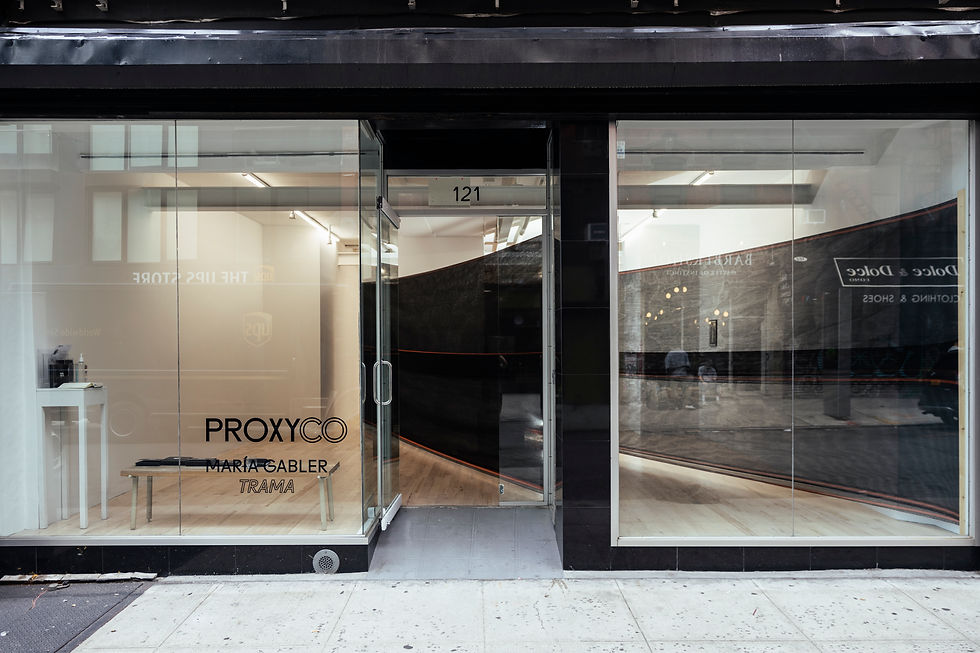


Trama (2022)
Malla de andamio, modelo a escala del espacio de la galería, fragmentos de contrachapado, asfalto, caja de contrachapado, video de 12 min y fotografía digital.
Trama se desarrolló durante una residencia de cuatro meses en el International Studio & Curatorial Program (ISCP) en Nueva York. La exhibición se estructuró a partir de una intervención dentro de la galería utilizando malla de andamio para confinar el espacio, conectando el muro central con el ventanal que da a la calle. Dentro de este cerramiento se ubicó un modelo arquitectónico original de la galería —recuperado de su depósito—, el cual quedó físicamente inaccesible para los visitantes y solo visible desde el exterior a través del vidrio de la ventana.
Junto a esta instalación, la muestra incluyó videos, fotografías y objetos producidos a partir de materiales recuperados durante investigaciones en el entorno urbano de Nueva York. Una pieza central consistió en una réplica de madera del modelo de la galería rellena con asfalto, el cual se vaciaba gradualmente bajo su propio peso y viscosidad. Este proceso de degradación material fue documentado en un video exhibido junto al contenedor de madera vacío.
* Exhibido en Proxyco Gallery, Nueva York. Desarrollado en el marco de la Residencia ISCP y financiado por la Beca Arte CCU.
Fotos: Luis Corzo.
María nos hace conscientes de aquellos materiales fantasmas que configuran significativamente nuestro entorno, al emplear objetos cotidianos que encontramos en las calles de Nueva York: la malla para cercar una obra en construcción, el asfalto que cubre las calzadas, la madera contrachapada que sirve de encofrado para esta selva de concreto. La entrada «original» tiene en realidad dos vanos, algo que no había notado en un principio. El espacio se transforma al instalar una malla negra que comienza en el pilar de la puerta de entrada, ubicada al centro de los dos vanos/vitrinas. La malla se adentra en la galería, rodea una pared falsa y entonces regresa al otro borde de la vitrina, que es también el extremo de la galería. El resultado es una estrecha entrada que obliga a ponerse de lado para atravesarla -y que yo había pasado inadvertidamente-, con el fin de llegar al «espacio de exposición» donde están todos los «objetos de arte».
Ruo Jia
Fragmento del artículo Post-Trauma publicado en Revista Artishock
Leer texto completo (ES)
--------
Trama (2022)
Scaffolding mesh, scale model of the gallery space, plywood fragments, asphalt, plywood crate, 12 min video, and digital photography.
Note on translation: A literal English equivalent for the Spanish word "trama" is not possible, as it simultaneously denotes both "plot" (narrative/conspiracy) and "weft" (the woven structure of a fabric).
Trama was developed during a four-month residency at the International Studio & Curatorial Program (ISCP) in New York. The exhibition structured an intervention within the gallery using scaffolding mesh to enclose the space, connecting the central wall with the street-facing window. Inside this enclosure, an original architectural model of the gallery—retrieved from its storage—was placed so that it remained physically inaccessible to visitors, rendering it visible only from the street through the window glass.
Alongside this installation, the exhibition featured videos, photographs, and objects produced from materials retrieved during research in the urban environment of New York. A central piece consisted of a wooden replica of the gallery model filled with asphalt, which gradually emptied itself under its own weight and viscosity. This process of material decay was documented on a video displayed next to the empty wooden casing.
* Exhibited at Proxyco Gallery, New York. Developed as part of the ISCP Residency and supported by the Arte CCU Scholarship.
Photos: Luis Corzo.
Using everyday objects on the streets of New York —the mesh to enclose a construction site, the asphalt that lays the roads, the plywood that goes way back in María’s oeuvre that serves as formwork for the concrete forest—that are ghost materials which significantly create our environment, María is bringing them to the forefront of our awareness. The “original” entrance space is actually double bayed compared to what I first perceived. It is recreated by installing a black mesh envelope that starts from the middle mullion between the two bay-ed storefront windows and the entrance doorway, enclosing a short wall-slab on the side of the entrance, and circle back to the other side of the window, which is also the edge of the space. The result is a new entrance space that I experienced, with a black meshed “wall” and a white plastered wall leading to a small entrance gap that one needs to turn sideways in order to squish through, that I rushed in unnoticed, in order to get into the “exhibition space” that I found all the “art objects.”
Ruo Jia
Fragment of the article Post-Trauma published on Artishock Magazine
Proceso y registros de la residencia ---------- Process and documentation of the residency


